“I suppose you’ll be the one to write my obituary.”
My dad was giving me a ride to the airport after one of my infrequent and characteristically brief visits to my hometown of Moline, Illinois, a few years ago. I wasn’t surprised by the question, and I knew it wasn’t just small talk. My dad didn’t do small talk. At the time he was ninety-four, and was probably thinking an obituary would eventually be needed.
He figured I would be the one to do his obit because I was the member of the family who made a living as a writer. It wasn’t too long before that that I learned my father was a bit of a writer himself. He shared newsletters he had written for various organizations he belonged to. I apparently inherited my knack for snarkiness from him.
It wasn’t a long conversation; it’s a short ride from his house to Quad Cities International Airport. He just wanted to make sure I included his military duty; that was most important to him. I said I would. And I told him that if I went first he would probably be the one to write my obituary. I was only half joking. I was in my late sixties and the lines on our actuarial graphs were starting to converge.
But in late January, Dad died. Up until about two months before that it looked as though he would make it to 100. He still lived alone in a two-story house (with a basement, too!) and a few months prior had gotten his drivers’ license renewed, to the chagrin of my siblings and me. But a couple of falls and a botched hip replacement proved too much to overcome. I was on a cruise ship heading for the Panama Canal. So I took my laptop to a quiet place and kept my promise to him. This is what I wrote:
“James Robert Joseph, a veteran of World War II, the Korean conflict and the Vietnam War, died peacefully at his home in Moline on Tuesday, Jan. 28. He was 97.
Joseph, known variously to family, friends and colleagues as Jim, Bob, Joe or even Jimmy Joe, was born in Chicago on Sept. 1, 1927, to David and Marguerite (Jones) Joseph. He attended public schools in Chicago and Rock Island, graduating from Rock Island High School in 1945. He served in the U.S. Navy from 1945, toward the end of WWII, until 1948, and enlisted in the U.S. Army in 1950 during the Korean conflict. He worked as an equipment specialist for the Rock Island Arsenal’s Weapons Command for nearly 38 years, retiring in 1983.
During his time with the Arsenal, he traveled extensively to such places as Ethiopia, Greece, Korea, Japan and, most notably, Vietnam, where he served as a civilian for the Department of the Army over multiple deployments.
On June 24, 1950, he married Alta L. Hatton, with whom he had five children: James Robert (Bob), Scott, Daniel, Marguerite (Maggie) and John. The marriage ended in divorce. He married Joyce Nickell in 1976.
Survivors include his children and their spouses: Bob (Sheri), East Moline; John (Marina), Moline; Maggie Shepard (Paul), Phoenix; and Scott (Rick Schell), Orlando. He is also survived by a granddaughter, Morgan Joseph, and two great granddaughters, Penelope and Piper Frederiksen, all of Moline. He was preceded in death by his son Daniel; wife Joyce; longtime companion Patricia Smith; and his sister, Marjorie, and her husband, Sherman, whom he considered a brother.
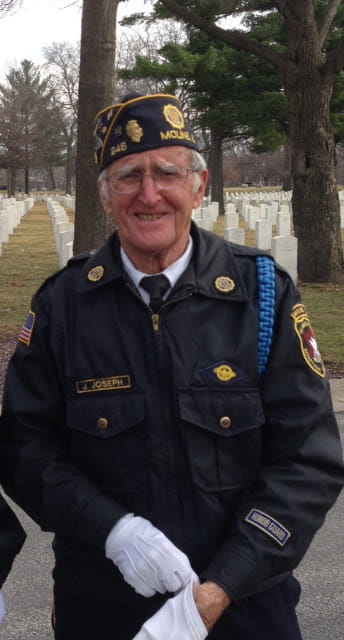
He was a life member of the Moline American Legion, the Moline Veterans of Foreign Wars, and an honorary life member of the Vietnam Veterans of America. He belonged to Moose Lodge 190 in Rock Island and Friend’s Circle in Moline. He was also a universal blood donor, contributing more than 29 gallons during his lifetime.
He was commander of the Moline American Legion Honor Guard, performing ceremonial duties for nearly 6,000 funerals of Quad Cities veterans. He was once asked by a reporter why he participated in the Honor Guard. He said he saw it as his duty to give fellow veterans a proper sendoff.
On Wednesday, Feb. 12, the American Legion Honor Guard will accord him the same rites. Those wishing to attend should gather at Wendt Funeral Home in Moline at 11 a.m. for the 11:15 drive to the National Cemetery on Arsenal Island.”
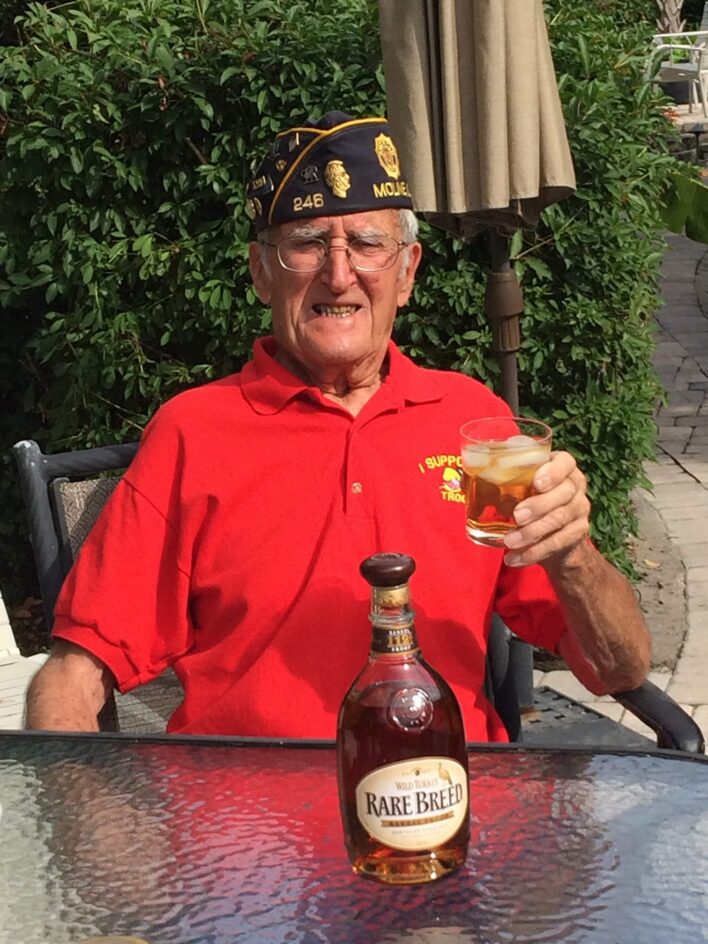
But there’s only so much an obituary can convey. There was much more to know about my father that I couldn’t work into the published account. Such as that he was so much a military man that he stipulated his ashes were to be put in an ammo can for burial. That he had a ready reply whenever someone asked his secret to longevity (bourbon). That although he and my mother had been divorced for four decades he had wanted her ashes to be added to that ammo can. Or that he never ended our weekly phone call without telling me to say hello to Rick.
But there was something that had happened when we kids were young that to me either defined my dad or added to his mystery – I still haven’t decided which. I refer to it as the Gravy Incident.
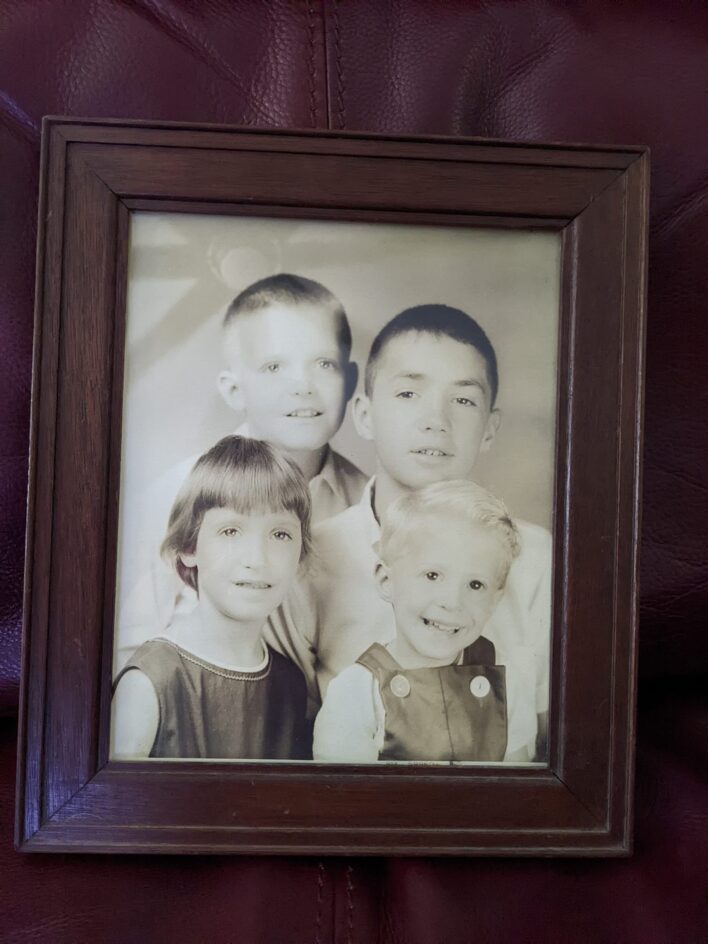
It was sometime in the mid nineteen-sixties. I was probably still in grade school; Dad would have been in his mid thirties. Our brother John was born with hemophilia, a disorder that prevents blood from clotting. So what would be a simple bruise for anyone else would turn into a purple blotch that would cover a whole arm or half his body, or a small pinprick would just continue to bleed until he could be treated with a clotting factor. Unfortunately, little was known about the disease – indeed, the Daniel mentioned as the predeceased son in my dad’s obit, who was born when I was one year old, bled to death at 16 days old following a circumcision; my family never knew why until John was born seven years later and diagnosed with hemophilia.
None of the hospitals in the Quad Cities kept clotting factor on hand. The university hospital in Iowa City, an hour’s drive away, was the closest place for treatment. So when John would fall or bump into something, as toddlers tend to do, one of my parents would have to drive him there, quickly, no waiting.
Usually it was mom because dad had to work. Mom had a job, too – tending a household and raising four kids. The cooking duties were also hers.
On this particular day, Mom had already started dinner when John hurt himself and it was clear that a trip to Iowa City would be necessary. So Dad, just home from his job at the Rock Island Arsenal, would have to finish cooking and feed us.
Dad was not a cook. At least not in those days. And I do not remember what it was that Mom had been making that night, only that it was something that would normally be served with gravy. Whatever the dish, it almost certainly could have been served without the sauce, and all of us would have eaten it up regardless.
But Dad dove into making the gravy, probably from having watched Mom do it a hundred times effortlessly.
I sat down at the kitchen table with my younger sister, Maggie, and older brother, Bob. We waited patiently as Dad put the finishing touches on the meal and dished everything up. He put the plates in front of us and then set the gravy boat in the middle of the table. Then he got a spoon and stuck it in the gravy. The spoon stood straight up. Even when one of us tried to give the spoon a little shove, it didn’t budge. It was a bit reminiscent of Camelot’s sword in the stone.
The three of us looked at each other and tried not to snicker. Although my father had a great sense of humor, self deprecation wasn’t a strong point, so we knew we shouldn’t laugh.
But then we couldn’t help it and we all started to laugh out loud. And even Dad eventually smiled.
Over the years, especially after we had grown and moved on, we would refer to the Gravy incident, usually when we would get together at holidays and watch Mom masterfully make the gravy.
But while Dad’s gravy was a disaster, at least he tried.
A few years before he died I asked my dad why he even bothered to try making gravy when he clearly didn’t know how. “I like gravy,” he said matter of factly.
So do I. And I didn’t learn how to make it until I was sixty years old.
So at this time of year when many people will attempt to make gravy to go with the turkey and stuffing, here’s the way to do it.
Pour the pan drippings into a fat separator. Many recipes will tell you to use the roasting pan to make the gravy, removing all but, say, two tablespoons of fat. How you determine you’ve left only two tablespoons of fat in the big roasting pan is something I’ve never figured out. Plus, the bottom surface of the pan is just too vast. Use a large sauce pan instead.
In the fat separator, the grease will rise to the top; that’s the stuff you want to use, but don’t throw out the drippings on the bottom. Put two tablespoons in the sauce pan and turn the heat to medium high. (More on amounts in a moment.)
When the fat is hot, add two tablespoons of all purpose flour and start stirring. (You can use a whisk if you want but a wooden spoon works just fine.) If it feels like the fat and flour are too hot, turn the heat down a bit.
What you’re making here is a roux. Continue to cook the roux for a few minutes. You want it to get a bit dark, especially if it’s for your turkey, but you don’t want it to burn.
It’s going to be dry and clumpy but don’t let that worry you. Once the roux is the color you want it (and if it isn’t very dark that’s fine too), it’s time to start adding the liquid, usually stock, a little at a time. (If I’m doing turkey, I put the neck and giblets in a pot of water to simmer several hours to make a stock to use in the gravy. Or you can use chicken stock.)
This is where people start to panic because the first bit of liquid added to the roux will get really pasty and steam will rise dramatically from the pot. Calm down, keep stirring and add a little more stock so the steam subsides and the consistency is no longer like library glue. Keep stirring, then add more liquid to this it out, and when it starts getting thicker again, add more stock. Let it thicken a bit each time before adding more liquid, then stop and taste when it’s the consistency you want. At this point I’ll add some of the pan drippings from the bottom of the fat separator to give the gravy a bit of flavor. Season with salt and pepper, maybe a shake of Worcestershire sauce.
My usual formula is 2-2-2: two tablespoons fat, two tablespoons flour, two cups stock. If you want more – and of course you do – scale it up: 4-4-4 or 6-6-6 (not the fertilizer mix).
And adjust as you go. If it’s too thick, like my dad’s was so many years ago, add more stock and keep stirring. Too thin, sprinkle in a little flour (just a little at a time, that stuff blooms).
And just keep telling yourself: “I like gravy.”
Happy Thanksgiving.